
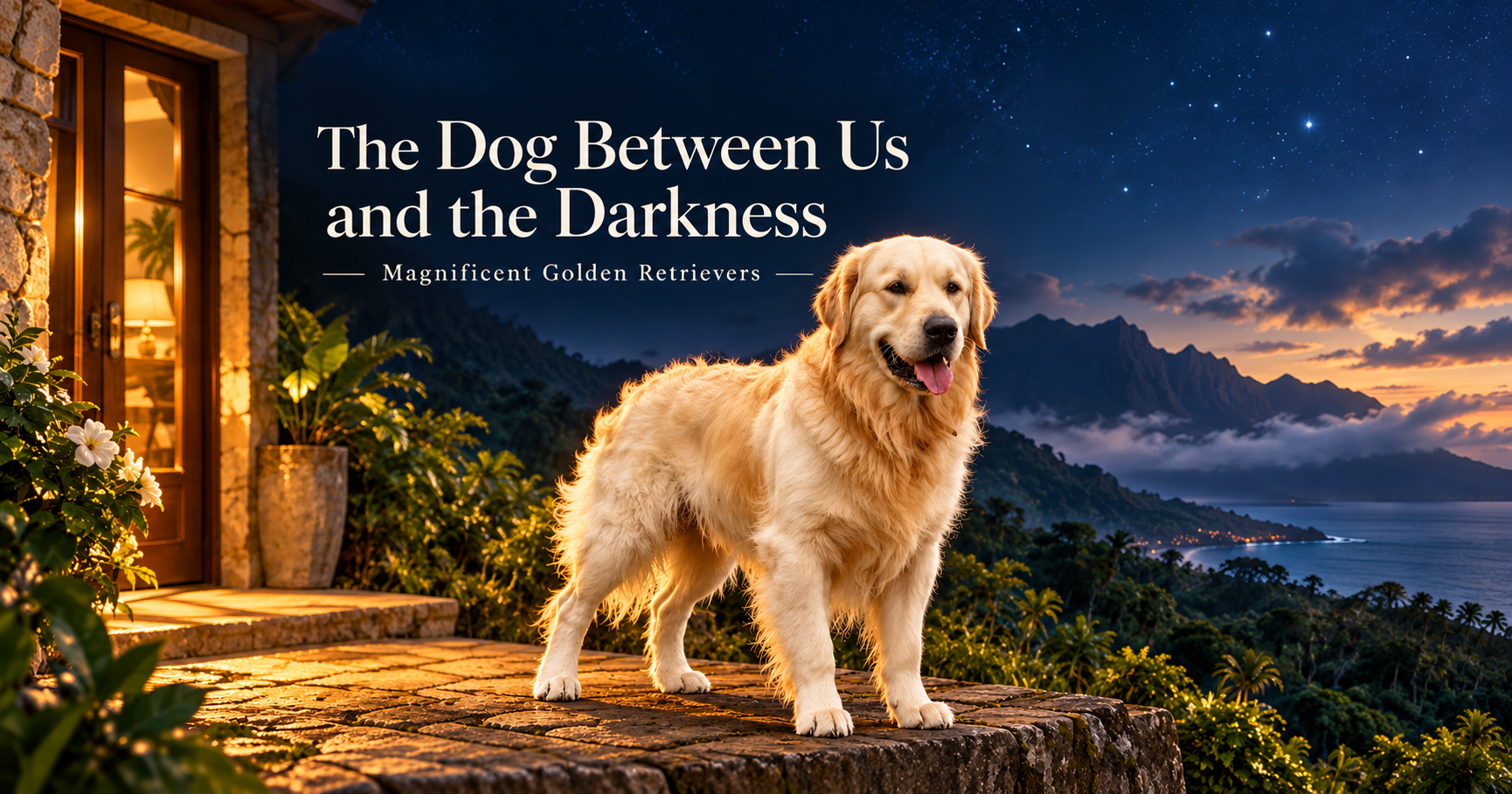
Dog Between Us and the Darkness
A reflection on the seven duties of the dog
There is something deeply reassuring about a dog settling near the doorway as a house grows quiet. The family goes to sleep. A head rests on a pair of paws. An ear turns toward a sound outside. Even at rest, our companion seems to keep a small part of its attention on the world beyond us.
A story about the Anunnaki gives that familiar scene a striking meaning. In the video that inspired this reflection, these divine figures bring a dog from the heavens to stand between humanity and the dangers beyond the firelight. The account gives the dog seven duties, each concerned with protecting the people and the place it has accepted as home.
I offer this as a reflection on a modern mythic telling. Its claimed Sumerian tablet and translation remain unverified. The story invites us to look more closely at the animals beside us and consider what their presence means.
There is an authentic ancient connection worth appreciating. In Mesopotamian religion, dogs were associated with Gula, a goddess of healing. Protective dog figurines were also buried beneath doorways; a group found at Nineveh dates to about 645 BCE. People gave the image of a dog a place at the entrance to their homes, where safety met uncertainty.
The seven duties below follow the video’s description. The reflections accompanying them are my own.
1. Guard the perimeter
The first duty is to hold the edge of the home. It brings to mind the familiar dog pausing at a gate while the rest of the family carries on nearby. We may be absorbed in a conversation or watching a child play. The dog has noticed movement at the fence. That moment of attention is a small service, easily overlooked because it asks so little recognition.
2. Watch the road
The second duty turns the dog’s attention toward whatever is approaching. I find a tenderness in that image, because a road brings people home as well as bringing strangers. Anyone who has been greeted by a Golden Retriever knows how quickly watchfulness can become joy. A sound becomes familiar, a body begins to wiggle, and the arrival of one ordinary person becomes the happiest event of the afternoon.
3. Attend to those who enter
The third duty concerns those who cross the threshold. In our own homes, a dog often becomes part of the welcome, approaching to investigate and deciding how close it wishes to be. We should leave room for that individual response. A dog’s hesitation deserves patient attention, though it cannot tell us a person’s moral character. Trust grows best when neither the dog nor the visitor is forced into it.
4. Mark the boundary
The fourth duty gives the boundary a recognizable presence. It makes me think about how thoroughly a dog comes to belong to a place. There is a favorite patch of shade, a worn toy beside the steps, a bed that somehow occupies the busiest part of the room. Gradually, a house gathers evidence of a shared life. We make room for the dog, and begin to find the rooms strangely empty without it.
5. Break the silence
The fifth duty is to sound the alarm. A bark interrupts us, sometimes at an inconvenient hour, and our first response may be irritation. This part of the story invites a moment of curiosity before impatience. What has the dog noticed? Is it worried, excited, or asking for help? Caring for a watchful companion includes responding calmly and helping it settle. It should feel safe in the home it shares with us.
6. Draw the protective ring
The sixth duty introduces the image of a protective circle. I read that circle as a beautiful symbol of belonging. A dog may spend an evening moving between family members, resting beside one person and then finding another. To imagine a circle around those people is to picture everyone included, everyone accounted for. It is the shape we hope a home will take around the lives entrusted to it.
7. Stay beside the sleeper
The seventh duty, the binding of the sleeper, imagines the dog’s closeness anchoring a sleeping person’s inner light within the body. For me, this is the most moving image of all: someone finally able to rest, with a warm companion nearby. There are evenings when the day’s troubles follow us into bed. A dog breathing quietly beside us can give our attention somewhere gentler to land. For that moment, there is a familiar life within reach.
These duties also invite a broader understanding of darkness. In our own lives, it can be loneliness, grief, or the strain of a difficult day. A dog cannot explain those experiences away. It may still bring a toy, ask for a walk, or lean against our legs while we stand in the kitchen. Those ordinary invitations help keep us involved in the world around us.
For those of us who share our lives with Golden Retrievers, the story has a particular warmth. Their companionship often arrives with an expression of hopeful interest and something carried proudly in the mouth. A Golden may welcome a guest with the very toy it refused to surrender five minutes earlier. There is room in the idea of a guardian for that generosity, and for the comfort of a creature that makes a home feel welcoming.
At Magnificent Golden Retrievers, this is part of what makes the bond worth honoring. A puppy will become someone’s daily companion. Its place in that person’s life will be built through small routines: breakfast, walks, greetings at the door, and quiet time together as the years pass.
Any reflection on a dog’s duties should also lead us to our own. We owe our dogs patient teaching, appropriate care, exercise, and the freedom to rest without having to monitor every sound. We owe them kindness when they are young and trying to understand us, and tenderness when age makes familiar things difficult. The companion we imagine guarding our sleep deserves to sleep peacefully too.
Perhaps that is the image to carry from this story: a dog resting close enough to touch, its watchfulness softened by trust. When the house grows quiet tonight, reach down and let a hand rest gently on that familiar head.
There is someone beside you. Make sure they know you are beside them, too.