
Ethical Breeding Is Breeding Out Ichthyosis

Ethical Breeding Is Breeding Out Ichthyosis
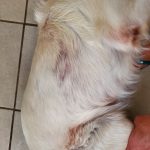
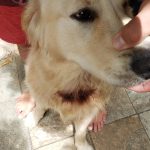
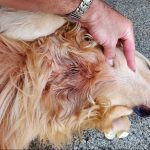
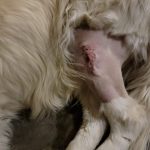

-

- A showstopper if it weren’t for a difficult to heal oozing hotspot under his feathery chest
Ichthyosis: The Hidden Cause Behind Chronic Hot Spots and Ear Problems in Golden Retrievers
If you have a Golden Retriever who suffers from chronic hot spots, recurring ear infections, greasy or flaky skin, odor, or irritated patches that seem to disappear only to return somewhere else, you may have spent years asking the same question:
Why does this keep happening?
If nobody has ever given you a satisfactory answer, this article may contain the information you’ve been looking for.
I know that frustrating cycle because I lived it.
Years ago, I shared my life with a Golden Retriever named Rio Grande #1 who suffered from ichthyosis. For a long time, it felt as though the condition stole my best friend—and my wallet.
What should have been a carefree Golden Retriever life became a constant battle against flaky and oily skin, recurring ear problems, bacterial hot spots, odor, and the expense of repeatedly trying to keep him comfortable.
Nobody brings home a Golden Retriever expecting to spend years managing a genetic skin disorder.
But that was my reality with Rio.
Eventually, with experience and the guidance of my veterinarian, I learned what was happening and, more importantly, how to stay ahead of it.
And I learned that ichthyosis can be much more than the “flaky skin” it is so often described as.
Ichthyosis Is More Than Flaky Skin
Ichthyosis compromises the skin barrier.
The skin is the body’s first line of defense against the outside environment. When that protective barrier is compromised, bacteria can more readily take advantage of the damaged skin. The result can be recurring bacterial hot spots—sometimes appearing again and again on different parts of the dog’s body.
That was the cycle I experienced with Rio.
And ichthyosis did not always look like the photographs and simple descriptions of “flaky skin” I had encountered.
It could manifest as scaling. It could produce greasy, oily areas. At times there could be larger patches of abnormal skin that became moist, irritated and oozy. And it could manifest through the recurring bacterial hot spots that became such a familiar part of managing his condition.
That is one of the most important things I want Golden Retriever owners to understand: ichthyosis can be much more than dandruff.
If you keep treating the hot spot without understanding why your dog’s skin is allowing the problem to recur, you can find yourself endlessly treating the symptom without ever understanding the underlying condition.
Once I understood that Rio’s compromised skin barrier was allowing bacteria to gain a foothold much more easily, the recurring hot spots finally made sense.
Instead of treating each hot spot as though it were an entirely new and unrelated problem, I began managing the underlying skin condition consistently.
That changed everything.
How I Discovered Rio’s Ichthyosis
For years, I knew what I could see with my own eyes.
Rio had chronic skin problems. He developed hot spots. His skin could become flaky, greasy, oily and irritated. His ears repeatedly developed bacterial and yeast problems.
But eventually I learned something much more specific.
I had Rio DNA tested through Embark, and his genetic health results revealed that he had inherited two copies of the ichthyosis mutation.
Suddenly, so much of what I had experienced with him made sense.
That experience is also why, when Golden Retriever owners ask me about genetic testing, I specifically recommend Embark DNA health testing.
Not all DNA tests necessarily screen for the same genetic variants. Golden Retrievers have known genetic variants associated with ichthyosis, and Embark’s health testing includes testing for the recognized Golden Retriever ichthyosis variants.
That distinction matters to me.
If I’m trying to determine whether a Golden Retriever carries a known genetic defect, I don’t simply want a result saying the dog is “clear” when the laboratory tested for only one particular variant. I want comprehensive testing for the known variants relevant to the breed.
That is why Embark became my testing choice.
Don’t Take My Word for It—Test Your Golden Retriever
This is where I want to issue a challenge to Golden Retriever owners.
If you found this article because your Golden Retriever has suffered from chronic, recurring hot spots, particularly when those hot spots occur alongside flaky or greasy skin, recurring bacterial skin problems, odor or chronic ear infections, don’t simply take my word for what I’ve written here.
Test your dog.
Use an Embark DNA health test and look specifically at the dog’s ichthyosis results.
In fact, I’ll go further.
If your Golden Retriever has been plagued by chronic hot spots and the pattern I’ve described sounds remarkably like your dog, I would not be surprised if an Embark DNA health test reveals that your Golden inherited two copies of an ichthyosis-associated mutation.
You don’t have to accept my experience with Rio as proof of what is happening with your dog.
Find out.
Swab your dog’s cheek. Send in the DNA. Read the results.
Does your Golden have zero copies, one copy, or two?
I genuinely encourage owners struggling with these problems to find out.
Because that is precisely how I discovered what was happening with Rio.
I had spent years dealing with what appeared on the surface to be a collection of different problems—hot spots, abnormal skin, recurring ear infections and microbial problems.
Then his DNA gave me the missing piece:
Rio had two copies of the ichthyosis mutation.
From that point forward, I stopped looking at ichthyosis as merely “flaky skin.”
I had lived with what it could look like.
The Hot Spots and Ear Problems Can Go Hand in Hand
Rio’s recurring ear problems were another part of the same picture for me.
His ears were particularly prone to bacterial and yeast infections.
My understanding became that his body was already continually dealing with the consequences of compromised skin and recurring bacterial problems. His immune system was being asked to deal with those challenges over and over again, while his ears provided another environment where bacteria and yeast could flourish.
The pattern became unmistakable to me:
Skin problems. Hot spots. Ear problems. Treatment. Improvement. And eventually another flare.
Once I stopped looking at each problem as an isolated event and began treating Rio as a dog living with an underlying genetic skin disorder, managing him became much easier.
Managing Rio’s Ears
Once I understood what I was dealing with, consistency changed everything.
Rio’s ears were particularly prone to chronic yeast and bacterial infections.
My routine started with witch hazel applied to a cotton ball. Using my pinky, I would gently remove accumulated debris while helping dry excess moisture from the ear canal.
After cleaning, I applied Zymox Ear Solution with 1% hydrocortisone. The hydrocortisone helped calm inflammation while the formula helped us stay ahead of the bacterial and yeast problems that repeatedly affected him.
This was simple, inexpensive and something I could do consistently at home.
Rather than waiting until every problem became severe, I learned to recognize the earliest signs and stay ahead of them.
Once I learned his patterns, this routine allowed me to manage many problems before they became severe enough to require another costly veterinary visit.
Of course, a severely painful, swollen, bleeding or persistently infected ear still warrants veterinary attention. Home management isn’t a substitute for veterinary care when a dog genuinely needs it.
But there is an enormous difference between responsibly managing a chronic condition at home and repeatedly waiting until every flare becomes an emergency.
Managing Rio’s Skin
His skin required the same vigilance.
Depending upon how he was doing, I bathed him weekly or every other week using chlorhexidine shampoo.
Drying him completely afterward was extremely important.
Once he was thoroughly dry, I applied a thin layer of coconut oil to rough, dry or irritated areas as needed.
There wasn’t a miracle medication.
The secret was consistency.
Keep the skin clean.
Keep it dry.
Watch for the earliest signs of trouble.
Deal with a developing hot spot while it is small rather than waiting until it becomes a large, painful, oozing lesion.
Once I understood Rio’s condition and developed a routine, I became much better at managing something that had previously seemed overwhelming.
And importantly, I learned that staying ahead of his symptoms didn’t necessarily require spending large amounts of money every time something appeared.
Nutrition Matters
Nutrition was another part of my approach.
I supplemented Rio’s diet with omega-3 fatty acids from sardines and fish oil and incorporated fresh foods such as eggs, lean meats and bone broth.
Nutrition wasn’t going to change the genes Rio inherited.
But supporting his skin, coat and overall health became another component of managing the condition rather than simply reacting whenever another hot spot appeared.
Even One Copy Matters to Me
There is another point I believe Golden Retriever owners and breeders need to understand.
Ichthyosis is commonly discussed as a recessive genetic condition. Dogs carrying one copy of an associated mutation are generally classified as carriers, while dogs inheriting two copies are genetically affected.
But my experience has made me unwilling to dismiss carriers so casually.
A Golden Retriever carrying a single copy of an ichthyosis mutation can sometimes exhibit mild or subtle skin symptoms resembling aspects of ichthyosis.
Those symptoms may be considerably less pronounced than those seen in a dog carrying two copies, but this is one reason I personally don’t regard “carrier” as equivalent to the genetic standard I want in my breeding program.
For me:
Clear means clear.
My objective isn’t merely to prevent puppies from inheriting two copies.
I don’t want them inheriting even one.
You Can Learn to Stay Ahead of It
This is particularly important for the Golden Retriever owner who found this article because you’re frustrated.
Maybe you’ve already spent hundreds—or thousands—of dollars dealing with recurring skin and ear problems.
Maybe another hot spot has appeared and you’re wondering what you’re doing wrong.
Maybe you’ve treated your Golden’s ears repeatedly, only to have the odor, debris and irritation eventually return.
Maybe you’ve been told that ichthyosis is essentially just flaky skin, yet what you’ve been living with doesn’t seem minor at all.
You need to know that there may be an underlying reason these problems keep happening.
Once I understood Rio’s ichthyosis and learned his skin, I stopped feeling helpless every time something appeared.
I knew what I was looking at.
I knew what I needed to stay ahead of.
And I learned that many of his day-to-day symptoms could be managed inexpensively and effectively through consistent care rather than allowing every small problem to progress until it became a major one.
That knowledge changed my experience of living with an affected Golden Retriever.
But Rio Taught Me Something Even More Important
Eventually, I became pretty good at managing Rio’s condition.
But I shouldn’t have had to.
And neither should he.
No dog should have to inherit a preventable genetic condition simply because people decided that producing carriers or affected dogs was acceptable.
Think about the Golden Retriever life we all picture.
Swimming in the ocean.
Splashing through streams.
Running through wet grass.
Rolling in the dirt.
Coming home filthy, exhausted and happy.
Now imagine constantly having to consider whether moisture against compromised skin is going to produce another bacterial hot spot, whether another irritated patch is developing underneath that beautiful Golden coat, or whether those ears are beginning to smell again.
Rio could still live a happy and fulfilling life.
I loved him no less because of his condition.
But after living through it with him, I reached a simple conclusion:
Managing ichthyosis is good. Preventing it is better.
How We Break the Cycle
When the time came to bring another Golden Retriever into my life, genetic testing became non-negotiable.
That experience ultimately helped shape the philosophy behind Magnificent Golden Retrievers.
All of our breeding dogs undergo genetic testing before breeding.
And our standard goes further than simply arranging breeding pairs so that puppies won’t inherit two copies and therefore be genetically classified as affected.
We do not intentionally produce puppies carrying the ichthyosis mutation.
Through careful genetic testing and selection of breeding pairs, our goal is that every puppy we produce inherits:
Zero copies.
Not two.
Not one.
Zero.
Why set the standard there?
Because today we can.
Modern DNA testing gives breeders information that breeders of previous generations simply didn’t have. We can identify these mutations before deciding which dogs to breed.
Once we possess that information, we have a choice about what we knowingly pass to the next generation.
I made mine because of Rio.
If Your Golden Retriever Keeps Getting Hot Spots, Find Out
If you’re reading this because your Golden Retriever is struggling with chronic hot spots, recurring ear problems, flaky or greasy skin, or the seemingly endless cycle of treating one problem only to have another appear, I want you to remember one thing:
You can test this.
You don’t have to wonder whether what I’ve described has anything to do with your dog.
Get an Embark DNA health test.
Look at your Golden Retriever’s ichthyosis results.
And if your Golden has been plagued by chronic bacterial hot spots for years, I am particularly interested in what that test says.
Zero copies? One copy? Or two?
Rio’s DNA test showed me what I had been dealing with all along.
Once I knew, the years of apparently unrelated symptoms suddenly fit together.
Then I could concentrate on managing the condition rather than continually wondering why the problems kept returning.
Rio taught me how to stay ahead of ichthyosis.
He taught me what it could look like beyond simple flaky skin.
He taught me the value of genetic testing.
And ultimately, he helped establish a genetic standard for every Golden Retriever I would breed afterward.
Rio taught me how to manage ichthyosis.
More importantly, he taught me why I never want to produce it.